1. Pictura rescripta
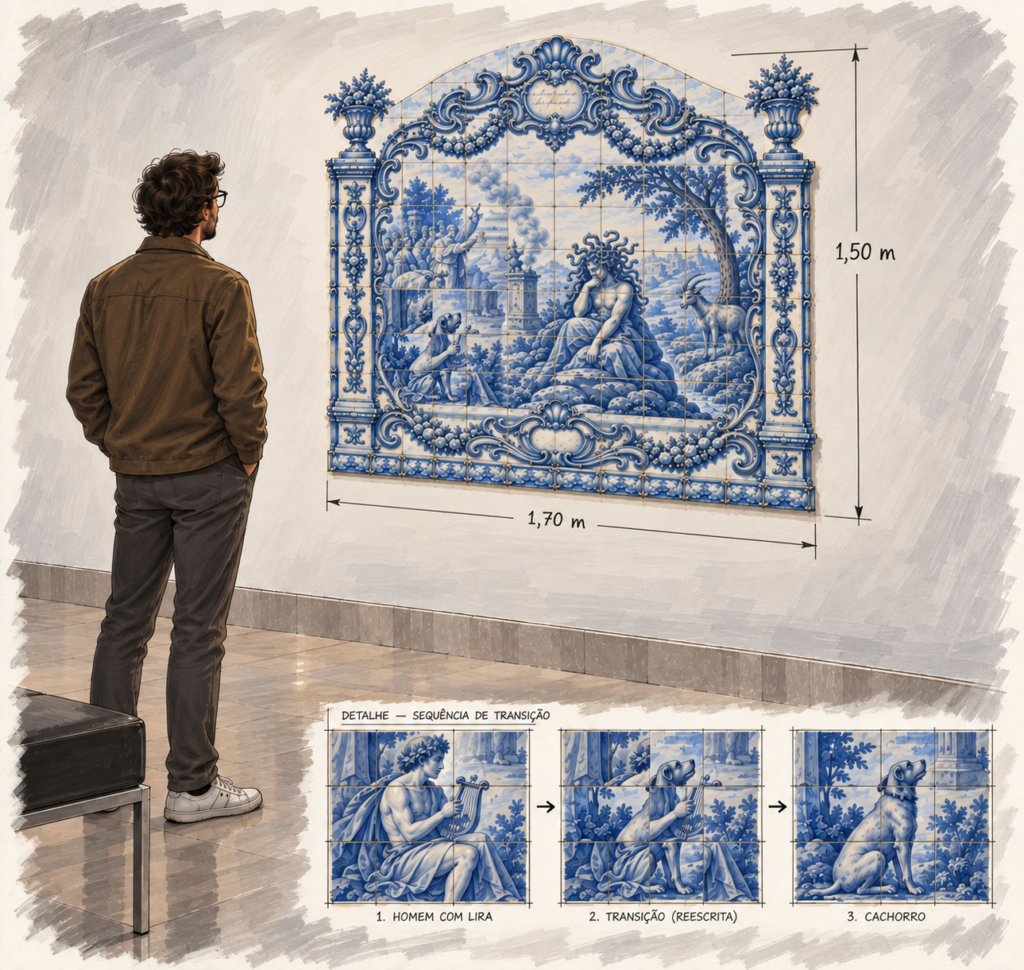
A wall of blue-and-white Portuguese tiles whose figures do not stay put. Behind a real ceramic grid, four electronic-paper panels hold scenes drawn from Otto van Veen's Emblemata Horatiana (Antwerp, 1607). When a visitor stops in front of the wall, one figure is slowly replaced by another — and the moral of the emblem is no longer what it was.
Pictura rescripta is a wall of Portuguese azulejos — 48 tiles in an 8 × 6 grid, roughly the size of an A0 sheet laid on its side — built from four colour electronic-paper panels set behind a real ceramic tile grid with real grout. Nothing on the wall emits light; like a tile, it is seen only by the light of the room. The panels carry figurative scenes in the blue-and-white idiom of classical Portuguese tilework, drawn from the emblems of Otto van Veen’s Emblemata Horatiana (Antwerp, 1607) — a book later circulated in Spanish as Theatro Moral, whose engravings supplied moral scenes to tile panels across the Portuguese world. The reference case is the cloister of the Convent of São Francisco in Salvador, Bahia, where 37 panels laid between 1746 and 1748 carry emblems chosen from the 103 images of the book; which edition the friars worked from cannot be established.
The figures do not stay put. When a visitor stops in front of the wall, one figure — a person, an object, a piece of scenery, occupying whole tiles — is replaced by another. The replacement is not instantaneous: electronic paper repaints slowly, and the eighteen or so seconds in which the old figure gives way to the new are the material of the work, not a defect. The viewer sees before, during, and after.