3. Imago Latens
Instant camera with embedded AI that returns two instant photos of the visitor, one faithful to reality and another in which only the human figure is reinterpreted by the algorithm
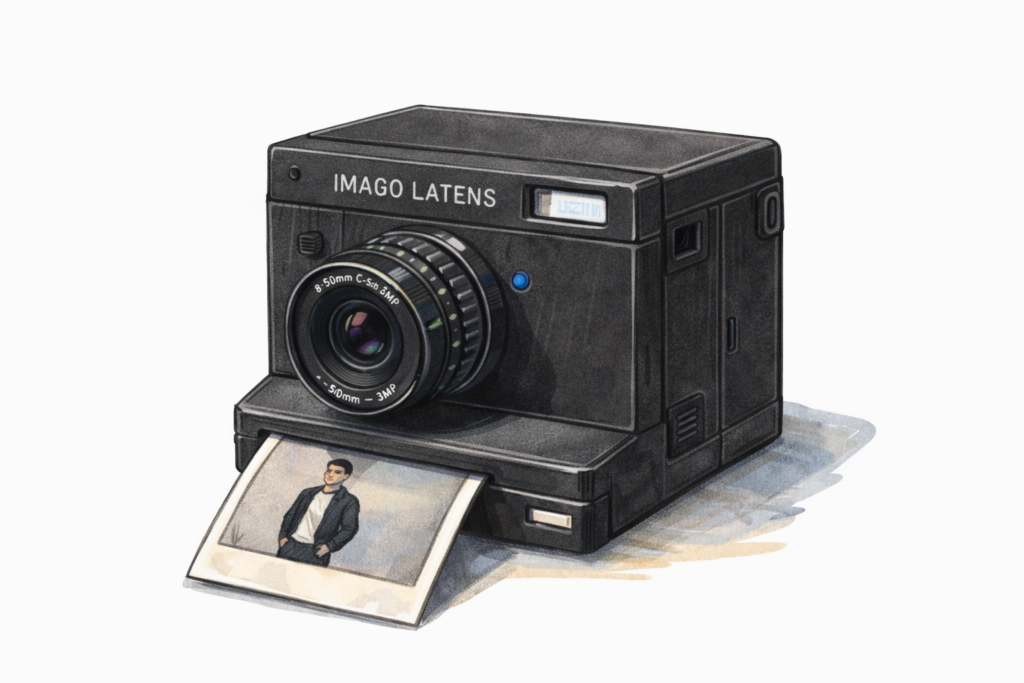
Imago Latens is an instant photographic camera with embedded artificial intelligence that captures visitors and returns two instant photos on Instax Square film: one faithful to reality and another in which only the human figure is reinterpreted by the algorithm, against the same background. By keeping the setting unchanged and modifying only the subject, the work exposes the structural bias of computer vision systems and materializes, as a physical and shareable object, the proposition that the machine does not capture who you are, but who it expects you to be. Conceived as an itinerant work, with local and offline AI processing, Imago Latens shifts the debate on artificial intelligence from technical abstraction to the terrain of everyday experience: the banal gesture of taking a photograph becomes a small rite of exposure to the algorithmic gaze.
The machine does not capture who you are, but who it expects you to be.
Imago Latens — Latin for “latent image” — is a handmade instant camera with an embedded AI system. From a single shot, it produces two instant-film photographs: one faithful to reality, and one in which the background remains untouched while the subject is reinterpreted by a generative model.
The camera does not capture who you are, but who the algorithm expects you to be. By preserving the real scene and rewriting only the body, the work inverts the logic of social media filters — and points the critical lens at how computer vision systems see, classify, and reimagine people. The visitor recognizes the place and the pose, but not quite themselves: a statistical doppelgänger, printed on film.
Each portrait is processed entirely on the device. No image ever leaves the camera — capture, segmentation, and generative reinterpretation all run offline on embedded hardware. This is not just an engineering choice: a work that questions biometric surveillance and data extraction cannot itself feed that chain.
For nearly two centuries, instant photography stood for immediacy and proof. Here, the same gesture — a print ejecting from a camera — delivers a generative fiction with no visible trace of manipulation. The visitor leaves with both prints: bias as a shareable, physical artifact.
The camera pairs a compact single-board computer with an instant-film printer. Each portrait is processed locally: no image ever leaves the device, and the transformation model runs entirely offline.
Technical specifications
| Capture | Sony IMX477 sensor (12.3 MP, 1/2.3″) with 8–50mm C-mount varifocal lens |
| Processing unit | NVIDIA Jetson Orin NX 16GB, 2TB NVMe storage — fully offline, no cloud connection |
| AI pipeline | Vision-language captioning (Qwen2.5-VL-3B) → human segmentation (u2net) → generative inpainting (SDXL); subject reinterpreted, real background preserved |
| Processing time | ~100 seconds per diptych, on-device |
| Output | Fujifilm Instax Square film via Bluetooth LE printer; two prints per visitor — one faithful, one algorithmically reinterpreted |
| Interface | 5″ touchscreen (kiosk mode) and physical shutter button; mediated operation |
| Power | 12V DC, ~30–40W; mains or 118Wh battery pack |
| Data policy | All images archived locally per session, offline only, under signed consent (LGPD) |